The Australian public is querying the value that Universities deliver and there is an urgent need to rebuild trust and confidence in the sector, Deakin University Vice-Chancellor Iain Martin has said.
Professor Martin has developed a new framework that Deakin will implement to reclaim social licence with its community, focusing on building four pillars to change perception – building legitimacy, demonstrating credibility, creating and leveraging on relationships of trust and lastly, practicing accountability.
“A strong case can be made that our sector has lost clarity of a shared sense of purpose: it is lost in a cycle of sectoral competition and the pursuit of global reputations, rankings, and other individualistic concerns,” Professor Martin said.
“These are not merely questions of policy or funding, equity, teaching, or research. Instead, it highlights the essential role of universities in 21st-century Australia, and the Licence of the Australian people for our sector to act.
“Being in receipt of such significant public financing, we exist to serve. Despite our significant successes in education and research, we face a perception problem. And that has evolved into a problem of social licence.
“If modern, multicultural Australia is to blend diversity with cohesion, clarity of values and jointly held ideals, and a shared vision for our prosperous and secure future, universities must be at the epicentre.
“From skills and employment barriers to the research powering new industries and breakthroughs, and the core social infrastructure of a healthy democracy, we have a major role to play.
“But we can only fulfil this role if the public has faith in what we offer, our statements, aims, ambitions, and actions. Where the public has such faith, the political system will reflect this value, supporting it through funding and priority of place.
“There are many models that look to understand social licence but sitting at the heart of most are four principles, that together form how we consider our Pillars of University Social Licence.
Leading the charge in not just wringing hands over the failure of the Australian public to appreciate the sector’s greatness, Deakin has developed a practical plan to being to win back support.
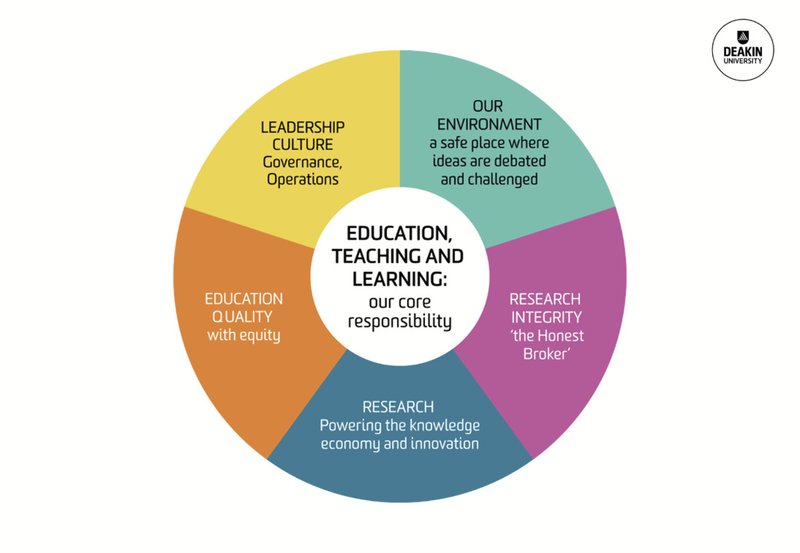
The plan pursues change across each area of university activity, summarised in the diagram above.
Given the attempts of the Universities Chancellors Committee and others across the sector to find a way forward, the Deakin plan stands out as an exemplar by acknowledging the issue and proposing practical solutions.
Professor Martin, one of the sector’s most senior leaders, will explore the approach to regaining social licence at HE FEST 25 next month.
“Unless our sector acknowledges that our social licence from the community is not a given, that we have a problem, and commits to tackling it in a collaborative and coordinated manner, we shall continue to struggle with our social licence.
“A head-in-the-sand mentality is unacceptable, and sector leaders must make this known both within our sectoral walls and in our external communications and engagement.
Rightfully, we should take pride in what we achieve each and every day. As institutions and a sector, we compete globally, and Australia benefits. Yet, we only do these things and have such an impact with the permission of the public and their goodwill.
“We can and must underpin our legitimacy in being critical to Australia’s future through a clear commitment to credibility, trust, and accountability.”